Digital Force Protection: From Signals to Operational Understanding
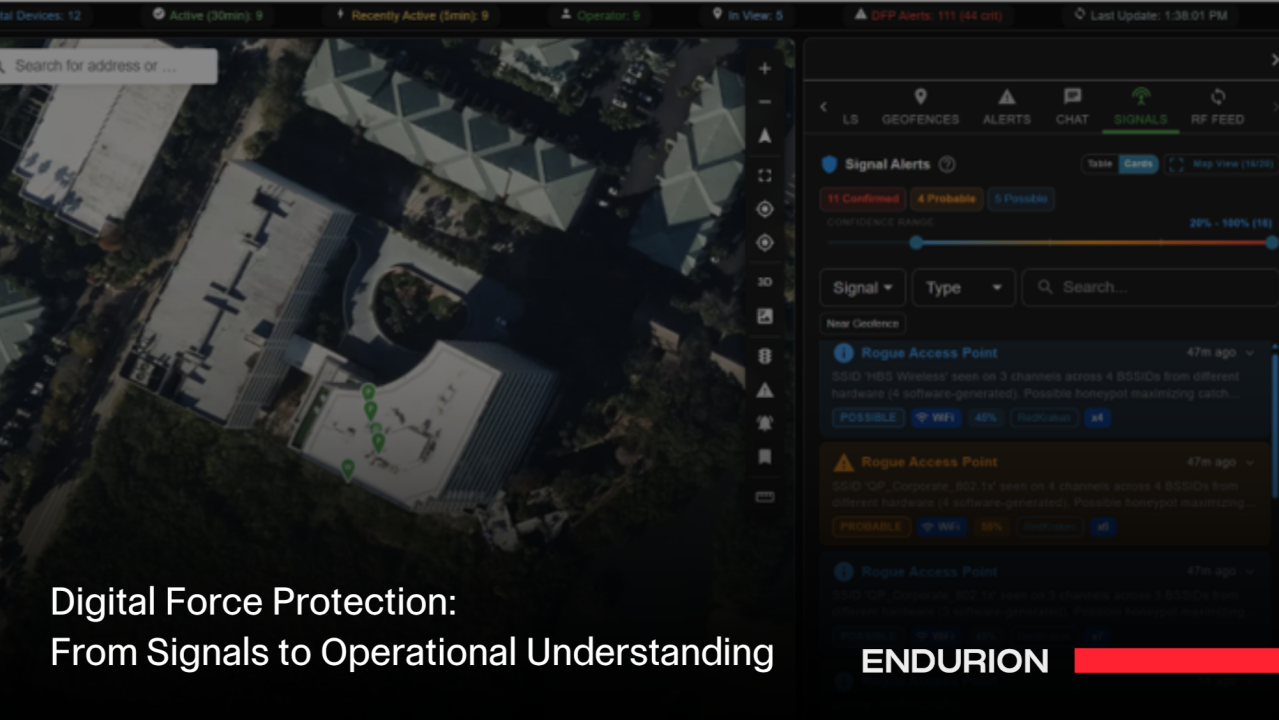
How Pathfinder turns fragmented device and signal data into explainable, mission-relevant awareness
Modern operations are increasingly connected. Smartphones, wireless networks, Bluetooth devices, navigation systems, unmanned aircraft, and other digital technologies help teams communicate, coordinate, and make faster decisions.
But every connected technology also creates a signature.
Those signatures can reveal the presence of personnel, expose patterns of activity, introduce unauthorized devices, or indicate that something in the operating environment has changed.
For force protection teams, the challenge is no longer simply collecting more data. It is understanding what the data means.
Digital Force Protection begins with three operational questions:
What changed? Why does it matter? What should the team do next?
That is where Pathfinder comes in.
Turning Fragmented Data Into Context
A single observation rarely tells the whole story.
A newly detected wireless device may be harmless. A change in GNSS behavior could be temporary interference. A Remote ID observation may belong to an authorized aircraft. A device near a protected location may not be significant on its own.
The picture becomes clearer when those observations are evaluated together.
Teams need to understand where something happened, when it happened, whether it was expected, what other activity occurred at the same time, and whether it violated a defined mission condition.
Traditional point solutions can detect individual events, but operators may still have to move between systems, manually compare timestamps, reconstruct activity, and determine which alerts actually deserve attention.
That fragmentation creates cognitive burden and can slow the transition from detection to action.
Pathfinder approaches Digital Force Protection differently: as an operational intelligence workflow, not a collection of isolated alerts.
A Mission in Motion
Consider a team establishing a temporary operating location in support of a sensitive mission.
Before operations begin, authorized personnel establish the mission area, expected devices, relevant time windows, known conditions, and alert thresholds. Pathfinder uses those parameters and approved data sources to establish an operational baseline.
During the mission, Pathfinder monitors supported observations across cellular, Wi-Fi, Bluetooth, GNSS, Remote ID, and other integrated data sources.
A previously unobserved device appears near the protected area. It remains present longer than expected and is later observed at another location associated with the mission. Around the same time, another deviation from the established baseline is identified.
Each event may have a reasonable explanation.
Together, they may justify attention.
Pathfinder correlates observations by time, location, behavior, and mission-defined rules. Rather than delivering another unexplained alert, it gives operators the context behind the finding: what triggered it, where the activity occurred, which observations contributed to the assessment, and why the combined behavior matters.
The force protection team can then review the supporting information, coordinate with the appropriate personnel, document the response, and resolve or escalate the event.
The final decision remains with the operator.
After the mission, the team can replay the timeline, review actions taken, capture lessons learned, and refine rules for future operations.
What began as fragmented technical data becomes a repeatable protection workflow.
From Detection to Decision
Pathfinder supports the mission across six key functions:
1. Establish the baseline Define what normal looks like for a specific mission, location, and period using expected devices, areas of interest, geofences, operating windows, and mission-specific conditions.
2. Detect changes across supported sources Apply configurable analytics to authorized observations and identify changes in presence, behavior, location, timing, or technical characteristics.
3. Correlate activity in context Bring technical data together with geospatial, temporal, and operational information to reveal relationships that may be missed when sources are viewed independently.
4. Prioritize what matters Use mission-defined rules, geofences, and compound conditions to elevate activity that warrants review.
5. Deliver explainable awareness Provide the observations, locations, timestamps, and analytic reasoning behind findings through maps, timelines, role-based views, and case workflows.
6. Improve through review Capture decisions and mission timelines to support after-action review, reporting, training, and continued analytic refinement.
The Operational Advantage
The goal isn't to generate more alerts.
It's to make the right information understandable and actionable at the point of need.
By correlating and prioritizing information, Pathfinder helps organizations move from fragmented detection toward coordinated protection with:
- Faster recognition of meaningful changes in the digital environment
- Reduced cognitive burden for operators
- A shared operational picture across technical and mission teams
- Traceable findings that support human-led decisions
- Repeatable workflows for response, reporting, and after-action review
- Integration with existing systems, sensors, and customer-controlled data
Making Every Signal Operational
Digital Force Protection requires more than advanced analytics. It requires disciplined data use, clear governance, and confidence in how findings are produced.
Pathfinder is designed to support authorized mission use through role-based access, data provenance, auditable activity, configurable workflows, and human oversight. It does not replace operator judgment or assume intent based on a single observation. Instead, it helps qualified personnel evaluate evidence in context and make informed decisions.
The modern operating environment is increasingly connected. Protecting the force requires an equally connected approach to awareness.
Pathfinder transforms authorized device, signal, geospatial, and operational data into a common, explainable view of what changed and why it matters.
By connecting detection, analysis, coordination, and review, Pathfinder helps teams reduce uncertainty and act with greater speed and confidence.
That is the purpose of Digital Force Protection: not simply to see more, but to understand sooner and respond with purpose.
Ready to see the difference?
Turn fragmented signals into operational understanding with Pathfinder.
Explore how Endurion can help your team detect meaningful changes, understand the context behind them, and make faster, more informed decisions.
Learn more at Endurion.com or contact us at demo@endurion.com to request a Pathfinder demonstration.